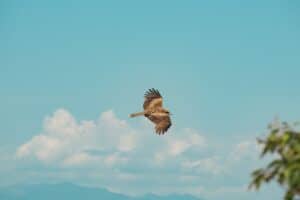
The forests, rivers, and alpine slopes around Hakuba provide habitat for a remarkable variety of birdlife. Here we meet five of our favorite birds and discover what makes them such special residents of Japan’s Northern Alps.
JAPANESE WOODPECKER (AOGERA)
The Aogera is a green woodpecker found only in Japan. It lives in forests throughout the country and grows to about 30 cm in length. Its olive-green plumage helps it blend into the trees. Males have a red crown, while females display red only on the back of the head. More often heard than seen, the species is known for its sharp calls and short bursts of drumming on tree trunks. Its diet consists mainly of insects such as ants and beetle larvae, although it will also eat fruit. Breeding typically takes place from May to July. The nesting cavities it excavates are later used by other birds and animals, making the Aogera an important contributor to the forest ecosystem.
WHERE TO SPOT IN HAKUBA? The forests of the lower mountain zone
MOUNTAIN HAWK EAGLE (KUMATAKA)
The Kumataka is a large forest raptor with broad wings, a long fanned tail, and a distinctive upright crest. Adults are dark brown with barred underparts and streaked throats, while juveniles are much paler. It hunts small to medium-sized animals like smaller birds (pheasants, pigeons) and mammals (hares, squirrels, raccoon dogs, macaques). Breeding begins in winter, with nests built in large trees and typically one egg laid. Known for its size and striking figure, it also shows strong loyalty to its nesting sites year after year.
WHERE TO SPOT IN HAKUBA? In the subalpine zone just below the treeline
ROCK PTARMIGAN (RAICHO)
The Raicho, which means “thunder bird,” has lived in Japan’s high mountains since the Ice Age. They are part of the pheasant family and are well adapted to the harsh mountain conditions. Their feathers change three times a year, from pure white in winter to brown in summer, with a mixed, patchy phase in spring and autumn. This allows them to match the changing alpine landscape and stay hidden from predators. Although hikers in Hakuba sometimes spot them above the tree line, sightings are special because the species is endangered, with populations declining due to climate change, habitat shifts, and increased predation.
WHERE TO SPOT IN HAKUBA? In the alpine zone above the treeline
GOLDEN EAGLE (INUWASHI)
The Inuwashi is one of the largest birds of prey in Japan. It has a dark brown body and very broad wings that spread like open fingers when it soars. Young birds show noticeable white patches on their wings and tail, which fade as they mature. It nests on rocky ledges along steep cliffs and usually lays two eggs. Its diet is varied, including animals such as hares, snakes, and small mammals. The Inuwashi is a non-migratory resident that lives mainly in mountainous regions, with each pair maintaining a territory of approximately 125 square kilometers throughout the year. In Hakuba, individuals have been seen flying from the ridgelines of Mt. Hakuba down toward the foothills, though sightings are rare.
WHERE TO SPOT IN HAKUBA? Alpine and subalpine mountain zones
CRESTED KINGFISHER (YAMASEMI)
The Yamasemi is a large kingfisher with a stocky body, ruffled crest, and bold black and white pattern that can look silvery at a distance. Found along fast-flowing rivers in Japan’s forests, it hunts fish by diving from branches. Breeding begins in spring, with nests dug into riverbanks. Known for its loud rattling call and striking appearance, it is often seen gliding along clear mountain streams. It can be seen around Oide Park, Himekawa River, and rice fields in the Hakuba area.
WHERE TO SPOT IN HAKUBA? Foothill zone and lower mountain zone